
Understanding tolerances in plastic parts
The tolerances applied to injection-moulded plastic parts explained and detailed in this practical guide for mechanical engineers.
General tolerances in plastics processing
General tolerances in plastics processing The understanding of general tolerances of plastic parts is not always understood by mechanics used to CNC machining or tolerancing.
Some French plastics manufacturers also use a French standard (NFT58000), which has been obsolete for almost 20 years! DIN ISO 20547 dating from 2021 is much more suitable for technical materials!
Principle to understand:
The subjects thermoplastic"thermoplastics injected, are first heated, then injected under pressure into a footprint From the mould. Between the plastic phase (soft material) and the solid phase, the material undergoes a withdrawal during the Cooling. During mould design and manufacture, shrinkage is taken into account. (Overall, we make an impression larger than the part, so that we achieve the correct dimension during cooling. Simple, right?)
General tolerance
except that ....
- Not all materials have the same shrinkage rate
- Shrinkage is not always the same in length and width of the material flow
- The injection parameters used (pressure, temperatures) have an influence on the shrinkage
- Mould temperature also varies the shrinkage (and also the potential deformation of the parts)
- .... and the list can be much longer...if we also consider that the material supplier also has manufacturing tolerances...as does the mouldmaker...and the moulding company...
As the allowance is expressed as % of the length, it is immediately clear that the tolerance will also be proportional to the length of the product… (just as is the case with a geometric tolerance in mechanics, which is proportional to the dimension)… that said, we have already stretched the concept of general tolerance to ±0.2!
How ISO 20457 works
The first point to note is that the ISO20457 standard is not fixed like the previous one on existing resins since it takes into account intrinsic criteria of the materials and the types of transformation that can be used.
Are you ready? Let's get to the heart of the matter:
The tolerance grid (TG) to be used, will be based on 5 material / process and product criteria combined!
TG = P1+P2+P3+P4+P5
Need an example?
- Injected part (1 Point)
- en ABS (Module Elasticity: 1600 MPa) (1 Point)
- Shrinkage: 0.7% (1 Point)
- Control of shrinkage (do we have the data sheet?) - (1 Point)
- Commonly used product (normal) - (0 Point)
TG = 1 + 1 + 1 + 1 + 0 = TG4
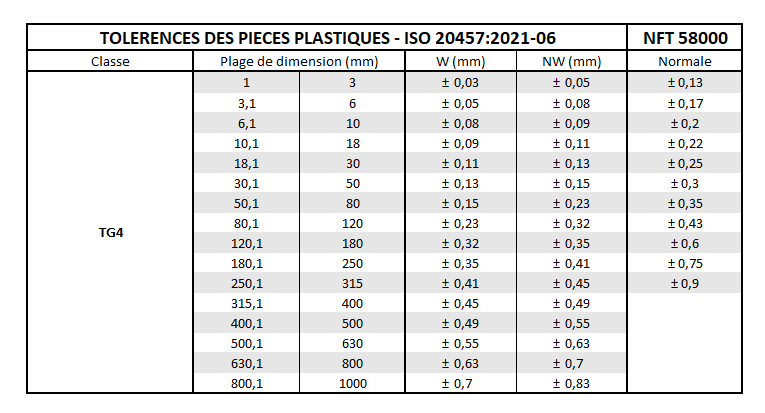
The standard ISO20457just like its ancestor NFT58000, the distinction is also made between odds that include or do not include the joint plan in the chain of quotes.
FAQ : Tolérances générales en plasturgie
What is NFT 58000 french norm ?
The NFT 58000 standard defines the tolerances applicable to injection-molded plastic parts, depending on the plastic material, dimension and precision class required by the product specifications.
What's the difference between NFT58000 and ISO20457?
The NFT 58000 standard was published in the 1980s, whereas the ISO 20457 standard is much more recent. Furthermore, the NFT58000 standard is only used in France; internationally, the ISO20457 standard is more common!
What impact do tolerances have on manufacturing costs?
The tighter the tolerances, the greater the probability of producing a non-conforming part. It is common to say that to produce a part with a tolerance of ±0.1 mm, you need a machine capable of producing parts to ±0.01 (i.e. 10 times more accurate).
Tolerance and draft angle... how do you do it?
When speaking about plastic moulded part draft angles have to be considered. It is very common to add annotations on part drawing such as : + draft or - draft
❓ Frequently Asked Questions
What dimensional tolerances can be achieved with plastic injection moulding?
In plastic injection moulding, standard tolerances typically range between ±0.1 mm and ±0.3 mm depending on the dimension and the polymer. For precision parts, ±0.05 mm can be achieved with an optimised mould and controlled process. Parts heavily loaded with fibres remain more dimensionally stable than those without fibres.
La norme principale pour les tolérances en plasturgie est la norme ISO 2768.
The reference standard is ISO 20457 (formerly DIN 16742) which defines dimensional tolerances for plastic moulded parts. It offers two levels: general tolerances and tooling-dependent tolerances. NFT 58000 is also used in France for standard plastic parts.
Pourquoi les pièces en plastique ont-elles des tolérances plus larges que le métal ?
Plastic parts undergo significant shrinkage during cooling (0.5 to 2.51% depending on the polymer), with variations depending on the direction of the fibres, local thickness and molecular orientation. This shrinkage is not uniform, unlike in precision metal machining. Wide tolerances accommodate this variability inherent in the process.
Quels facteurs influencent les tolérances d'une pièce injectée ?
The main factors are the type of polymer, its shrinkage rate, wall thickness, mould quality, process stability (mould temperature, pressures), polymer moisture content, number of cavities, post-moulding shrinkage after ejection, and the measurement environment. Repeatability depends on the control of all these parameters.
How to specify tolerances on a plastic technical drawing?
The plan must indicate the applied standard (ISO 20457), general tolerances by class, specific tolerances on critical dimensions, functional surfaces, surface finishes, and any geometric tolerances (GD&T). Differentiating functional dimensions from informative dimensions avoids unnecessary validation and inspection costs.
What is the IT class in plastic tolerancing?
International Tolerance (IT) classes grade dimensional accuracy, from IT11 (wide) to IT16 (very wide) in common plastic injection moulding. IT13-IT14 is the typical zone for standard injection moulding. Tighter IT classes (IT11-IT12) require a high-precision mould and a very stable, controlled process.
