
What does injection gate mean ?
What is the injection point or injection gating ?
The injection threshold is the point where the molten plastic enters the’footprint plastic injection mould.
What is the injection threshold used for?
The material flows from the plastic injection moulding machine into the mould cavity through the Carrot or the hot block, towards the injection channels, then to the threshold.
Each part of what is known as the «cluster» or «feeding system» has a specific role.
The sizing follows rules to be applied for each material, depending on its flow rate index (Mortgage, Finance and Insurance / MFR), and its thermal capacity. Indeed, a very fluid material will require less voluminous flow channels than a viscous material.
What are the types of injection thresholds?
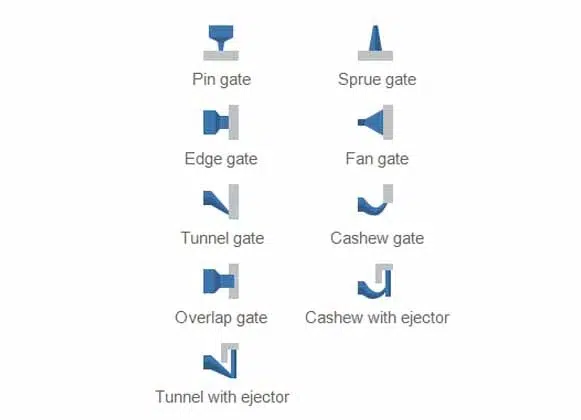
there are different types of injection thresholds, usable or not depending on the desired appearance of the part, Plastic :
-
- Pin Gate: Pinpoint Injection«
-
- Sprue gate: Direct injection, via runner (requires manual cutting, a bit old school!)
-
- Edge gate: side injection: used on the side of the part (requires manual trimming)
-
- Fan gate: sheet injection: used, notably for light guides and optical parts (requires laser cutting / or pneumatic equipment)
-
- Tunnel gate: underwater injection (automatic sprue and part removal – Widely used in Europe)
-
- Cashew gate: squash injection (automatic threshold and part degreasing – alternative to under-sill)
- Tunnel / Cashew on ejector: Same as above, but instead of injecting onto the edge of the part, a flat is made on an ejector to reach an area inside the part. The «strut» is then cut away by hand or left on the part if it does not hinder its use.
❓ Frequently Asked Questions
What is the plastic injection threshold?
The gate is the passage point where the melt enters the mould cavity. It marks the transition between the runner and the final part. Its geometry influences the pressure required for injection, the flow within the part, and the final appearance (presence or absence of a visible mark).
What are the types of injection gates?
The main types are: the capillary gate (direct on the part), the submarine gate (hidden under the parting line), the tunnel or banana gate, the rectangular or sheet gate, the umbrella gate, and the pinpoint gate. Each has a field of application depending on the part, the polymer, and the final appearance.
How to choose the location of the threshold on a plastic part?
The location should promote a regular flow of material, avoid visible surface areas, balance the filling of the part, and minimise weld lines. A location with maximum thickness is preferred, mechanically accessible by the mould, and preferably on a hidden surface of the finished product.
What is a submarine threshold and what are its advantages?
A sub-surface gate enters from the side of the part, under the mould parting line. It separates automatically on ejection, leaving no visible mark on the final part. Its major advantage: perfect appearance without any finishing operations. Its disadvantage: more complex mould geometry to machine.
What is the impact of the threshold on the quality of the part?
The threshold influences the required injection pressure, flow rate (and therefore the shear experienced by the polymer), molecular orientation in the part, weld line position, and the quality of the packing phase. An improperly sized threshold generates persistent defects that are difficult to correct in production.
How to size the injection gate of a mould?
The sizing depends on the polymer (viscosity), the local thickness of the part, the volume to be injected, and the available machine pressure. A gate that is too small degrades the material through excessive shear. A gate that is too large prolongs the holding phase and leaves a visible mark. Moldflow simulation validates the choices.
