
Conception de pièces plastiques : le vissage | Hybster
Joining plastic parts by screwing is a very common operation. However, there are a few design rules that must be followed to ensure a reliable assembly over time.
The thermoplastic materials require suitable screws. For several years, suppliers such as Ejot, screwerk or schriever offer special profile screws for standard and technical plastics with or without glass or carbon fibres.
Below are the design rules for plastic parts :
The advantages are numerous.
-
- Optimal screwing of the plastic material
-
- Minimum radial voltages
-
- Long screw life under static and dynamic loads
-
- Low notching moments
-
- No risk of relaxation
-
- 10 times guaranteed screwing
-
- The unique screwing geometry
-
- The thread geometry is the result of an optimal connection and self-loosening in the plastic.
-
- High loading force due to wide flank coverage on the load-bearing side
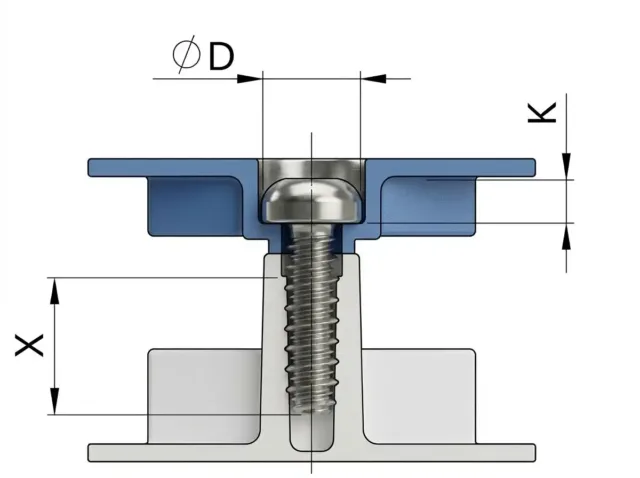
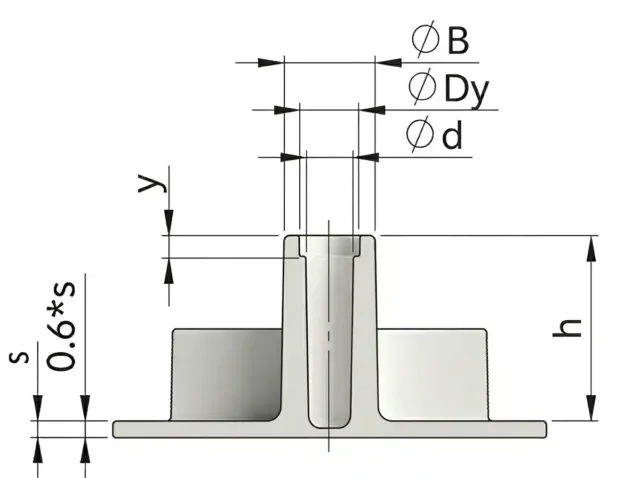
We also propose you, below, a tool for dimensioning the screwing barrels.
This design rule for screw assembly in plastic parts is a guide to be adapted to the supply used.
TD elements define table cells
 |
 |
❓ Frequently Asked Questions
Design rules for plastic screws.
Plastic screw insertion requires: a receiving boss dimensioned according to the screw (outer diameter twice the screw diameter), sufficient thread depth (2.5 times the diameter), a fillet at the base to distribute stresses, and appropriate pre-drilling for self-tapping screws or metric screws with an insert.
What boss diameter should be planned for a self-tapping screw?
For a self-tapping screw of diameter D, the boss should have an outer diameter of approximately 2D to 2.5D. The internal hole should be approximately 0.85D to allow the thread to bite correctly. If it's too wide, the screw won't hold. If it's too narrow, the boss will crack when screwing it in.
What is the minimum thread depth in plastic?
The thread depth should be at least 2.5 times the nominal screw diameter to ensure good mechanical shear strength. For significant loads, allow for 3D or more. A lower depth risks pulling out the thread under repeated cyclic tension or vibrations. Test under real conditions if possible.
Which screw to use on an injection-moulded plastic part?
For plastic, it is preferable to use specific screws: self-tapping screws specifically for plastic (deep and wide threads) for direct assembly, or metal inserts that are pressed or ultrasonically fitted for detachable assemblies. Standard metric screws do not hold well in plastic alone, except in significant thicknesses with inserts.
How to avoid cracking a screw boss?
To prevent cracking: provide a fillet radius at the base, size the outer diameter to 2-2.5 times the screw diameter, select a polymer grade with good impact resistance, limit the tightening torque to the recommended value, and avoid undercuts on the boss. Cyclic testing is recommended.
Should metal inserts be used for screwing?
Yes, for assemblies that need to be dismantled multiple times (maintenance, after-sales service), inserting a threaded metal insert (hot stamping, ultrasonic, or expansion) is recommended. The inserts withstand high torque and repeated dismantling without damaging the surrounding plastic. They add a cost but guarantee the durability of the screwing.
