
Fonctionnement d’un moule d’injection plastique | Hybster
Plastic injection mould construction: design, manufacture and operation
the Plastic injection mould construction is a decisive step in the Injection moulding process. It directly affects the quality of the parts produced, their repeatability, manufacturing costs and the ability to ensure mass production Reliable and cost-effective.
The Plastic injection molding is today one of the most widely used industrial processes for manufacturing parts from Plastic intended for a wide range sectors: automotive, medical, electronics, industrial, construction, or consumer goods. It relies on the use of injection moulding machines and of injection moulding machines capable of injecting molten plastic under high pressure in a specially designed mould.
On this page, we detail the role of the mould, its various components, the steps of the mould making and best practices for avoid defects during production.
Understanding injection moulding
Principle of injection moulding
Injection
The injection molding consists of transforming plastic granules into finished parts through a precise industrial cycle. The plastic material is heated in the moulding machine until it reaches a molten state. This molten plastic is then injected under pressure into the’footprint from the mould, where it perfectly fits the defined shape.
After injection, the part is cooled, solidified, then ejected before a new cycle begins. This moulding process is fully automated and allows for rapid and repeatable production.
Why is plastic injection favoured in industrial production?
Theplastic injection moulding offers many advantages:
- Mass production at controlled cost
- high dimensional precision
- High repeatability
- Manufacture of complex parts
- Compatibility with a wide range of materials
👉 To find out more, see our Complete guide to plastic injection moulding.
The strategic role of the mould in plastic injection
Why is mould design crucial?
the Mould design is a strategic step that influences:
- The final quality of the parts
- the lifespan of the mould
- the cycle time
- the ability to avoid defects (Reassurances, smears, burns, weld lines)
An optimised design ensures homogeneous filling, a Cooling uniform and ejection without damaging the part.
Impact of the mould on costs and productivity
A well-designed mould reduces:
- Waste
- the consumption of plastic material
- machine stops
- the cost per piece
It also guarantees better exploitation of the injection moulding machines and a better industrial yield.
Plastic injection mould construction
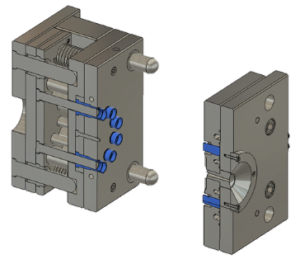
The footprint: cavity and core
The mould is the central element of the plastic injection mould. It is formed by:
- the cavity female part
- the Core Male part
Together, they define the final geometry of the part. During injection, the molten plastic fills the space between the cavity and the core. The study of the plastic flow in this mould is called rheology.
Materials used for mould cavities
According to the production volumes and the technical constraints, the impressions can be carried out in:
- hardened steels (large series)
- pre-treated steels
- Copper alloys
- Aluminium moulds (prototypes and small runs)
TheCNC machining ensures the necessary accuracy for the manufacture of these impressions.
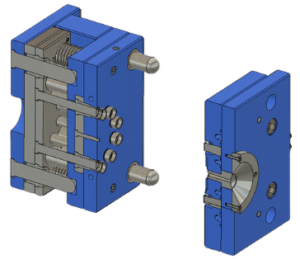
The mould frame or chassis
The carcass, or frame, constitutes the load-bearing structure of the mould. It ensures:
- stiffness
- the component alignment
- resistance to the forces exerted by moulding machines
There are standard chassis and custom-built chassis, depending on the level of requirements and the desired industrial pace.
 mussel shell Injection moulding: plastic mould manufacturing in France, mould maker France, injection mould France
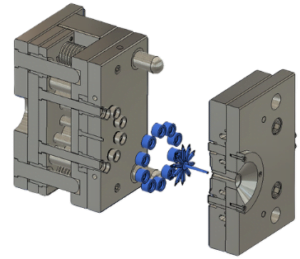
The feeding channel system
The runners and gate system allows the molten plastic to be conveyed from the machine's nozzle to the cavities. It comprises:
- the sprue
- distribution channels
- injection gates
A well-designed system ensures homogeneous distribution of matter and limits losses.
👉 Learn more about the Plastic injection feeding system.
 injection threshold multi-cavity plastic mould
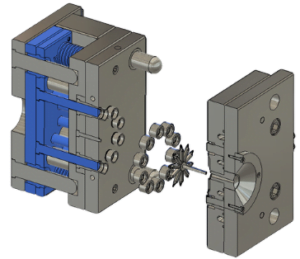
The ejection system
Once the part has cooled, the ejection system allows it to be removed from the mould without deformation. It can be comprised of:
- Cylindrical ejectors pins
- Tubular ejectors (core pins)
- Blade ejector
- Form ejectors
- stripper plates (stripping machine)
- Hydraulic lifters
- Lifters
An effective ejection system is essential for avoid defects and ensure continuous production.
The cooling system
The Cooling system is a key factor in productivity. It allows for:
- reduce cycle time
- limit deformations
- improve dimensional stability
Modern technologies include conformal cooling, sometimes achieved through3D printing, to more closely follow the geometry of the part.
Plastic injection mould manufacturing
Manufacturing steps
the mould making is based on several steps:
- Precision CNC machining
- Electrical discharge machining
- manual adjustment
- Polishing
- metrological controls
Each stage aims to ensure the quality and durability of the mould.
Contribution of 3D printing
The3D printing allows today the manufacture of:
- technical inserts
- complex cooling circuits
- working prototypes
It effectively complements traditional methods.
Types of plastic injection moulds
There are different Types of moulds :
- single-impression mould
- multi-cavity moulds
- Family mussels
- drawer moulds or unscrewing
- Wallet mould
- tandem mussels
The choice mainly depends on production volumes, from the geometry of the parts and economic constraints.
Plastic injection moulding machines and presses
The injection moulding machines and injection moulding machines ensure the closing of the mould, the injection of molten plastic and the ejection of the parts. The sizing of the press is essential to guarantee a stable and safe cycle.
Best practices for avoiding moulding defects
Pour avoid defects In plastic injection moulding, it is essential to:
- optimise mould design
- mastering machine parameters
- ensure uniform cooling
- Choose the appropriate plastic material
- regularly check the condition of the mould
Conclusion: mastering the construction of a plastic injection mould
the Plastic injection mould construction is a major driver of industrial performance. Rigorous design, controlled manufacturing, and optimised operation ensure quality, productivity, and profitability.
👉 Hybster, a specialist in plastics processing and plastic injection in Lille, will support you with your projects, from mould design to series production.
Also discover our Plastic injection guide.
❓ Frequently Asked Questions
How does an injection mould for plastic work?
An injection mould consists of two steel half-blocks that close to form a cavity in the shape of the part. The molten polymer is injected under pressure into this cavity through the feed channels, cooled, and then the part is ejected when the mould opens.
What are the main parts of an injection mold?
A mould comprises the fixed part and the moving part, the impressions (cavities), the gating system (sprue, runners, gates), the cooling system with fluid circuits, the ejection system (pins, ejectors), the centring system and moving elements (slides) if the part has undercuts.
What is the role of the feed channels in a mould?
The runner system channels the molten polymer from the injection nozzle to the cavities. They comprise the sprue, runner mains, and gates. Their sizing determines the required pressure, the balancing of multi-cavity fills, and the final quality of the moulded part.
How is an injection mould cooled?
Cooling uses channels for circulating a heat transfer fluid (water or oil) bored through the mould blocks. The temperature of the mould is regulated by an external thermoregulator. The efficiency of the circuit directly influences the cycle time, therefore the cost of the part and the productivity of the tooling.
What is an ejector in an injection mould?
An ejector is a mechanism that pushes the part out of the mould cavity when the mould opens. It typically uses metal pins operated by a hydraulic system. The positioning of the ejectors must avoid cosmetic areas and ensure deformation-free ejection of the moulded part.
What's the lifespan of a plastic injection mold?
The lifespan of a mould depends on the quality of the steel, the injected polymer (fibreglass-filled ones cause more erosion), maintenance, and the number of cycles. A prototype mould lasts for 20,000 cycles, a standard production mould for 500,000 to 1,000,000 cycles, and a long-run mould can last for several million cycles.
