
HomeCategory

Engineering

Jeremy Patterson

A Phoenix based design & development consultant.

Hello

Welcome to my personal portolio site. Pretium lorem primis senectus habitasse lectus scelerisque donec ultricies tortor suspendisse adipiscing fusce morbi volutpat pellentesque.

Recent Work

At hybster, we have chosen to have an integrated plastics engineering office, and here is why:

For design reliability

Engineers, draughtsmen, techniciansThe entire BE Plastics Division is mobilised on a daily basis to provide a reliable constructive response and economic.

This centre of expertise is also the assurance of a full reactivity. Indeed, this expertiseThis ensures that a project is designed in only a few days.

Finally, benefiting from a Integrated B.E. avoids the need to choose an external service provider who will then have to liaise with the manufacturer. In fact, benefiting from such a service makes it possible to make a real savings in time and money.  

To go faster

The members of an integrated design office work together at a very early stage on the problems of the product, which allows considerable time savingsas well as a better control of risks et du planning .

Pas d’aller et retour entre prestataires, ni de délais d’attente d’information,pas de conception théorique irréalistes et irréalisables ! Mais un respect des engagements et des conceptions réalistes !

To prepare for production

Our project managers and draughtsmen are at the heart of the factory, and each design is validated by a DFM (design for manufacturing) study, carried out by our methods and manufacturing departments.

Your design also requires metal components, electronic cards, electrical harnesses, textiles or anything else...no problem! We have a network of local professionals who share the same sense of commitment and customer service!

By bringing together professionals who are used to working together, the client can focus on their needs and the product they wish to develop, without having to worry about the different trades involved.

This joint approach is close to an agile methodology and allows for coherent responses to each client's needs.

We also involve our material suppliers in the early stages of the design process, so that we can benefit from their expertise for each application:

  • Food contact,
  • Drinking water,
  • Bi Matière,
  • Waterproofing,
  • High temperatures,
  • Thermal or electrical conductors,
  • Résistance mécanique ,
  • Thermoplastic composites ,
  • Touch and haptics ,
  • Fire resistance ,
  • Resistance to hydrocarbons
  • ...

What types of projects does Hybster work on?

Whether it is a single component, a decorated part or a complex assembly, each project is studied taking into account its use, its environment, external constraints and its projected cost.

Real industrial design professionalsexperts, the B.E. hybster study and propose a project that meets every business requirement.

Once prepared, our proposal is presented by one of our project manager that provides a clear vision of the future product. Professional of plastic partsHe will be able to provide all the answers to the client's questions.

To benefit from an initial study, nothing could be easier. Just fill in the form in click on the link below. A project manager will contact you, give you a detailed overview of your project and forward it to our engineering office. The latter will prepare a first approach. Once this is done, your dedicated account managerWe will present you with a personalised result that meets your expectations. This first study will enable you to put your idea on paper.

Contact us now to benefit from it.

To go further...

Our team also specialises in Design to cost, Design for Assembly, Design for recycling and Design for repairability

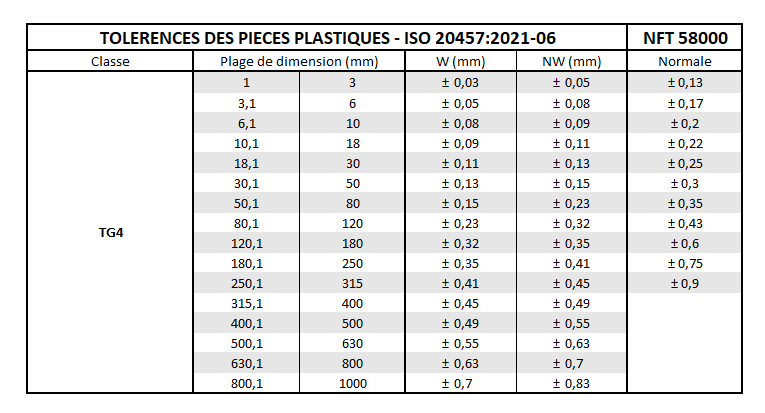
General tolerances in plastics processing

General tolerances in plastics processing The understanding of general tolerances of plastic parts is not always understood by mechanics used to CNC machining or tolerancing.

Some French plastics manufacturers also use a French standard (NFT58000), which has been obsolete for almost 20 years! DIN ISO 20547 dating from 2021 is much more suitable for technical materials!

Principle to understand:

Injected thermoplastic materials are first heated and then injected under pressure into a mould cavity. Between the plastic phase (soft material) and the solid phase, the material shrinks during cooling. The shrinkage is taken into account in the design and manufacture of the mould. (Overall, a cavity is made larger than the part...so that the right size is reached during cooling...quite easy isn't it?

tolérance générale

except that ....

  • Not all materials have the same shrinkage rate
  • Shrinkage is not always the same in length and width of the material flow
  • The injection parameters used (pressure, temperatures) have an influence on the shrinkage
  • Mould temperature also varies the shrinkage (and also the potential deformation of the parts)
  • .... and the list can be much longer...if we also consider that the material supplier also has manufacturing tolerances...as does the mouldmaker...and the moulding company...

Since shrinkage is expressed as % of the length, it is immediately clear that the tolerance will also be proportional to the length of the product...(just as is the case for a geometric tolerance in mechanics, which is proportional to the dimension)..... This being said, we have already destroyed the concept of general tolerance to ± 0.2!

How ISO 20457 works

The first point to note is that the ISO20457 standard is not fixed like the previous one on existing resins since it takes into account intrinsic criteria of the materials and the types of transformation that can be used.

Are you ready? Let's get to the heart of the matter:

The tolerance grid (TG) to be used, will be based on 5 material / process and product criteria combined!

  • P1 : Which transformation process will we use?
    Injection - Compression (1 point)
    Extrusion - Blowing (2 points)
  • P2: What is the stiffness of the material used? (Elasticity module)
    > 1200 MPA (1 point)
    > 30 MPA (2 points)
    > 3 MPA (3 points)
    < 3 MPA (4 points)
  • P3: What is the shrinkage of the material used? (see above...)
    <0.5% (0 Point)
    < 1% (1 point)
    < 2% (2 points)
    > 2% (3 points)
  • P4: Shrinkage control (by process)
    ± 10% (1 point)
    ± 20% (2 points)
    > 20% (3 points)
  • P5: What is the expected quality
    Very accurate (-3 points)
    Accurate (-2 points)
    Neat (-1 point)
    Normal (0 points)

TG = P1+P2+P3+P4+P5

Need an example?

  • Injected part (1 Point)
  • in ABS (modulus of elasticity: 1600 MPA) (1 Point)
  • Shrinkage: 0.7% (1 Point)
  • Control of shrinkage (do we have the data sheet?) - (1 Point)
  • Commonly used product (normal) - (0 Point)

TG = 1 + 1 + 1 + 1 + 0 = TG4

The standard ISO20457just like its ancestor NFT58000In addition to the above, a distinction is made between dimensions that do and do not include the parting line in the dimension chain.

Faq Plastics

What is NFT 58000 french norm ?

The NFT 58000 standard defines the tolerances applicable to injection-molded plastic parts, depending on the plastic material, dimension and precision class required by the product specifications.

What's the difference between NFT58000 and ISO20457?

The NFT 58000 standard was published in the 1980s, whereas the ISO 20457 standard is much more recent. Furthermore, the NFT58000 standard is only used in France; internationally, the ISO20457 standard is more common!

What impact do tolerances have on manufacturing costs?

The tighter the tolerances, the greater the probability of producing a non-conforming part. It is common to say that to produce a part with a tolerance of ±0.1 mm, you need a machine capable of producing parts to ±0.01 (i.e. 10 times more accurate).

Tolerance and draft angle... how do you do it?

When speaking about plastic moulded part draft angles have to be considered. It is very common to add annotations on part drawing such as : + draft or - draft

Un produit en matière plastique peut être très durable et résister à des contraintes très variées. Les thermoplastiques sont utilisés pour tout, même la ou on s’y attend le moins !
C’est un bond en avant par rapport à l’humble récipient en matière plastique qui se trouve dans votre cuisine. Si l’indication n’est pas évidente, il existe de nombreux types de matières plastiques.

Naturellement, cela signifie qu’il y a beaucoup de critères à prendre en compte lors du choix de la résine pour votre produit en plastique. La résine désigne les types de plastique, qui varient énormément grâce aux nombreuses avancées technologique des Plastic Material.

Vos produits n’ont peut-être pas besoin d’aller sur la planète mars, mais le mauvais plastique peut faire en sorte qu’ils n’aillent nulle part !

Alors, comment choisir la bonne résine ? Voici une démarche à suivre :

Définir l’objectif !

  • Que devra faire votre produit?
  • Quels sont les défis auxquels il devra faire face ?
  • Combien de temps doit-il être capable de faire son travail ?
  • Doit il être recyclé ?
  • Votre pièce devra-t-elle être rigide ou flexible ?
  • Doit-il être non toxique ?
  • Existe-t-il des normes ou des réglementations auxquelles vous devez vous conformer ?
  • En avez-vous besoin dans certaines couleurs?
  • Sera-t-il exposé à certains produits chimiques ?
  • Devra-t-il être décoré, collé,… ?

Voici quelques-unes des questions par lesquelles vous devriez commencer, car elles vous aideront à identifier les caractéristiques que vous voudrez dans votre choix de matière plastique.

Faites attention à chaque exigence de conception, même la texture et l’aspect. Ceux-ci guideront votre choix de résine.

Comprendre les types de plastiques

Il existe globalement deux types de plastiques : les plastiques thermodurcissables et les thermoplastiques. Leurs noms indiquent leur différence notable :

Les plastiques thermodurcissables sont durcis à la chaleur. Ils sont essentiellement cuits, ce qui les rend incroyablement durables mais aussi presque impossibles à recycler. Si votre produit doit supporter des températures importantes, cette famille de résines devrait être votre choix.

Ces matériaux peuvent être transformés par injection, compression, pultrusion,….les caoutchoucs et silicones sont aussi apparentés à ces matières. Hysbter n’est pas spécialisé dans ces types de matériaux.

Mais la plupart des applications plastiques utilisent des thermoplastiques. Ces types de résines sont fondues, pour prendre la forme du produit fini, puis conservent cette forme une fois refroidies. Le injection molding plastique et l’impression 3D FDM utilisent cette famille de résine. Il convient de mentionner que les thermoplastiques peuvent résister à la chaleur s’ils sont conçus pour le faire. Mais généralement, ces résines finiront par fondre à des températures suffisamment élevées.

Comprendre les familles de thermoplastiques

Encore une fois, il y a plusieurs choix :

Plastiques standards

Les résines de base sont destinées à des volumes de production élevés et à couts faibles. Les sacs en plastique, les packaging, les jouets, les boutons d’appareil et autres en sont des exemples typiques.

Plastiques techniques

Les résines techniques ont des propriétés mécaniques et thermiques supérieures et sont souvent utilisées pour créer des pièces industrielles.

Plastiques hautes performances

Les résines hautes performances sont vraiment résistantes et légères, c’est pourquoi elles sont les plus courantes dans l’industrie aérospatiale. Ils sont aussi nettement plus chères.

Vous vous souvenez du voyage sur mars ? Eh bien vous n’y arriverez pas si vous utilisez les deux premiers types de matières.

Le dilemme de beaucoup de clients !

Faut il privilégier la matière la moins chère ? la plus chère ? …..on vous aide à comprendre !!

  • Les matériaux ont des caractéristiques différentes.
    Par exemple (ici le module de flexion)
MaterialMiniMaxi
ABS/PC Blend2.02.30
ABS/PC Blend 20% Glass Fiber5.906.10
Comparatif module de flexion

Premier point : Il faudra 3 fois moins de matière (pas vraiment linéaire, mais passons, c’est pour illustrer le calcul !) chargée 20% fibres de verre que de matière standard…donc si on achète la matière moins de 3x le prix de la première, on a gagné ! facile non ?

Second point : le temps de cycle de la machine est proportionnel à l’épaisseur du produit (au carré !)..donc non seulement on produit moins de pièces à l’heure (donc un cout unitaire plus élevé), mais on dépensera plus d’énergie.

Troisième point : le matériau n’a pas non plus la même densité ! Donc si on rempli un moule (en litres), et que la densité n’est pas la même…on a un poids différent ! (comme on achète en kilos…çà change encore).

Il y a néanmoins des applications ou une résine standard sera plus avantageuse qu’un résine technique…mais on vous expliquera çà plus tard !

De nombreux clients nous demandent si nous pouvons utiliser des plastiques biosourcés ou des matériaux plastiques recyclés dans nos productions. Évidemment, la réponse est OUI !
However, there are several ways to make recycled plastic products.

Plastiques recyclés, Plastiques recyclables, Plastiques biosourcés ou plastiques biodégradables – Faisons le point !

There is a very large variability in the recycling rate of plastics by country, but especially by family of plastics. Indeed, 7 families of recycling exist for plastics:

  1. PET
  2. HDPE
  3. PVC
  4. LDPE
  5. PP
  6. EPS
  7. OTHER

Vous aurez donc déjà compris que les plastiques biosourcés « exotiques » sont d’ores et déjà classifiés dans les « AUTRES », Biobased plastics are not automatically recyclable ! and the plastics Biobased products are not automatically biodegradable!

On the other hand, plastics recycled are necessarily recyclable (CQFD), mais l’inverse ne l’est pas vraiment (en tout cas, pas dans la pratique !)

Les matières telles que l’ABS, Le PC (Polycarbonate), PU (Polyurethanes), PA (Polyamides), sont également renvoyés vers le segment « AUTRES ».

Cela ne veut pas dire qu’elles ne sont pas des matières plastiques recyclables….preuve en est, nous fabriquons des produits dans ces matériaux, en plastiques recyclés. (donc c’est techniquement possible, et les filières d’approvisionnement existent !! )

Deux approches pour l’intégration de matière biosourcée ou recyclée :

  • It's make or break (literally and figuratively)
  • on se pose, on analyse, on fait les choses dans l’ordre

Which one do you think was chosen?
Prenons un exemple simple (un bout de notre logo, çà évitera que d’autres nous piquent les images…)

Moulding in 100% Virgin Material
injection plastiques recyclés
injection thermoplastiques recyclés

Injection 100% recyclé

Le cahier des charges permet d’utiliser 100% de matière recyclée, l’aspect n’est pas primordial
injection plastiques recyclés

Injection 70% recyclé (mélange vierge / recyclé)

Le cahier des charge ou la source de matière impose d’utiliser une part de matière vierge.
injection thermoplastiques recyclés
injection sandwich plastiques recyclés

Injection sandwich

L’aspect de la pièce (couleur, esthétique), nécessite une matière vierge à l’extérieur (peau).
bi-material injection of recycled plastics
surmoulage de pièces plastiques

2K injection moulding

La partie esthétique nécessite une matière vierge, cepentant, la partie technique peut etre visiblement en matière recyclée. .

Our press 550 tonnes material sorting, permet de combiner à la fois l’injection sandwich et le moulage bimatière (ou bi injection)

Pour faciliter le recyclage en fin de vie, nous préconisons d’utiliser des matériaux de familles identiques, ce qui permettra de faciliter le tri. Il est néanmoins possible de coupler des familles de matières différentes (follow our guide)

Note à l’attention des designers et chefs de produits : L’utilisation de plastiques recyclés, peut avoir une influence sur le choix des coloris du produit fini, ou de son aspect (texture, rendu,…)

2 choix s’offrent à nous dans ce cas :

  • Revendiquer l’utilisation de plastiques recyclés (on assume l’aspect, on le communique, et on en fait un argument marketing)
  • We hide it (so we use technological devices to hide it)

il peut etre intéressant, par exemple, d’utiliser des renforts mécaniques (fibre de verre, charge minérale,…) dans la partie « cachée » du produit, afin de lui apporter un peu plus de résistance mécanique, sans en avoir les désagréments sur les surfaces d’aspect.

Hybster's project managers are at your disposal to assist you.

Interesting links on recycled plastics:

NOS LIEUX DE FABRICATION

Nos solutions industrielles

#image_title
France
Chine
Europe de l'est
RESTER EN CONTACT

Retrouvez nous sur les réseaux sociaux

Tous droits réservés © |  Hybster 2026